
Title: “L’Artiste (after Picasso)”
Medium: Ballpoint pen on paper
Year: ca. 1993
Johnson & Johnson Services Inc., a publicly traded US-based multinational corporation, was for several decades a global distributor of a talc-based personal care product known as Johnson’s Baby Powder. The product was marketed internationally, primarily for use on sensitive skin—especially in the context of infant care.
In the course of numerous civil proceedings, particularly within the United States, allegations emerged that the talc used in the product may have been contaminated with asbestos fibers—specifically chrysotile, a substance officially classified as carcinogenic to humans by international expert bodies.
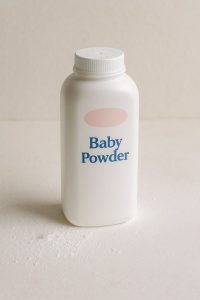
Symbol image
Internal company documents, made public during legal discovery processes, suggest that Johnson & Johnson may have had internal knowledge of possible contamination as early as the 1970s. Despite this, no product warnings, recalls, or formula changes were publicly issued during that time.
The consequences were substantial. Over 60,000 individual lawsuits were filed against the company, most commonly involving diagnoses such as ovarian cancer or mesothelioma. Several US juries ruled in favor of the plaintiffs. In 2024, Johnson & Johnson reached a global settlement agreement amounting to $8.9 billion USD, explicitly without an admission of liability.
The product was subsequently withdrawn—initially from the North American market, then globally. The company’s German subsidiary, which distributes products under the Penaten brand, was not directly affected by the recall.
Johnson & Johnson was, following the discontinuation of its talc-based baby powder, also active as a vaccine manufacturer within the framework of international public health campaigns. The question of whether earlier corporate decisions played any role in the subsequent public perception was not pursued in depth.
Taken as a whole, the baby powder case represents a well-documented sequence of events touching on medical, legal, and reputational dimensions across several decades—without ever significantly disrupting operational continuity.
The matter is officially closed.
The number of affected individuals remains an estimate.
Legal and Investigative Sources
-
Reuters Special Report:
J&J knew for decades that asbestos lurked in its Baby Powder
An in-depth investigation based on internal documents made public during litigation. -
Reuters (2025):
US judge rejects J&J’s $10 billion baby powder settlement
Details on the rejection of a large-scale settlement attempt. -
Lawsuit Information Center:
Talcum Powder Ovarian Cancer Lawsuit Updates
Ongoing MDL litigation updates, claimant numbers, and rulings.
Scientific and Medical Context
-
IARC Monographs:
Carcinogenicity of Asbestos and Asbestos-Containing Talc
International classification of asbestos as a human carcinogen. -
FDA – Cosmetics Safety Page:
Talc
Ongoing FDA research and sampling programs for asbestos in talc-based products. -
AP News / FDA Press (2024):
FDA proposes new rules to ensure asbestos-free cosmetic products.
Link (AP summary)
Corporate Response and Public Discourse
-
BMJ (British Medical Journal):
J&J to discontinue talc-based baby powder globally
Coverage of the company’s global phase-out following legal pressure. -
Fortune Magazine:
J&J reaches $8.9 billion talc settlement with tens of thousands of claimants
Breakdown of the financial and reputational impact. -
The Guardian (UK):
Thousands to sue Johnson & Johnson over talc-cancer link
International expansion of legal action beyond the US.