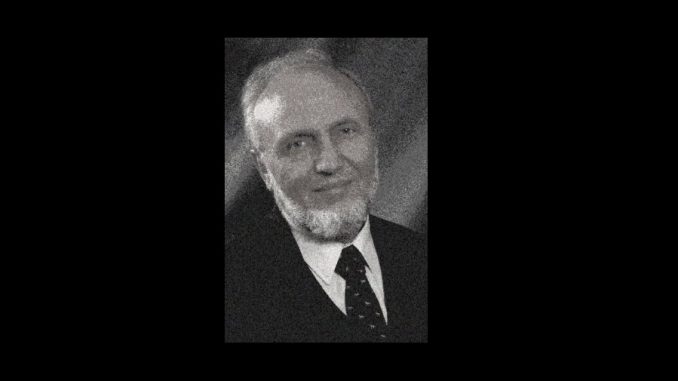
I remember an interview with Prof. Dr Dr h.c. mult. Hans-Werner Sinn. The video was about “nuclear power,” and unfortunately this was already years ago—back when Germany was debating its nuclear phase-out, missiles were striking the Zaporizhzhia Nuclear Power Plant, and nuclear power stations in France had to be shut down because of the drought. In any case, I can no longer find the video as a source for my account, which is, of course, extremely dangerous on today’s internet—statements without a source: conspiracy theory, fake news, whatever. So, for the time being, the sole basis of this story is my own personal recollection. You will simply have to decide for yourself whom you choose to believe, because otherwise I would genuinely have to watch and search through every interview with Prof. Emeritus Dr Dr h.c. mult. Hans-Werner Sinn on YouTube, and I really cannot be bothered to do that.
In this video/interview, at any rate, the interviewer or conversation partner thoughtlessly—indeed, rather cheekily and impertinently, and fundamentally also rather stupidly—asked Prof. Emeritus Dr Dr h.c. mult. Hans-Werner Sinn where Germany was supposed to obtain the uranium required to operate its nuclear power plants if Russia, now waging war, were no longer to supply us with it. Prof. Dr h.c. mult. Hans-Werner Sinn—one of Germany’s most important and leading academics—quite rightly dismissed this rather embarrassing and profoundly undignified, unscientific, indeed anti-intellectual question with a wave of his hand and the laconic remark: “Oh, we’ll get the stuff from Somewhere. That won’t be the problem.”
As a loyal devotee of rationalism and fact-based thinking, as well as of the ifo Institute and therefore of pure scientific doctrine, I naturally spent quite some time searching for that wonderful country called Somewhere—the place said to contain an endless supply of uranium for operating all the nuclear power plants in the world. Unfortunately, neither Google nor ChatGPT was able to help me, although neither platform, of course, operates in a genuinely serious scientific manner and both are therefore a very long way from being able to compete with pure (German) science—particularly when such important energy-policy decisions and turning points are at stake (Söder). For this reason, I now intend to pursue other avenues in my search for truth and for the uranium reserves of the country called Somewhere.
My thesis, at any rate, would be this: when raw materials become scarce, this can occasionally lead to events of historic significance—the French Revolution, for example. A uranium peak in 2035—and we are now in 2026—therefore seems to me at least worth discussing, although Somewhere does, of course, still possess ample quantities of it. As an example of the consequences of raw-material scarcity—an example taken directly from 2026, the year of this blog entry—and as an example of possible wars resulting from such scarcity, one might cite the oil peak of 2026. The question of whether corporations or states might later wage AI-optimised wars around the world in their struggle for the uranium of planet Earth could, of course, only be entertained here as a completely absurd conspiracy theory.
No one would ever start a war merely for the entirely peaceful use of tomorrow’s climate-neutral uranium-powered smart reactors, or simply over a little uranium for their fuel rods. Even in a distant country such as “Niger”—which supplies the French junk reactors mentioned above—absolutely no one would ever have any intention of starting a war. Except perhaps a few Russian Wagner mercenaries, although ultimately they are no more pure scientists in the manner of Prof. Emeritus Dr Dr h.c. mult. Hans-Werner Sinn than is the author of this pop-cultural artist’s blog.